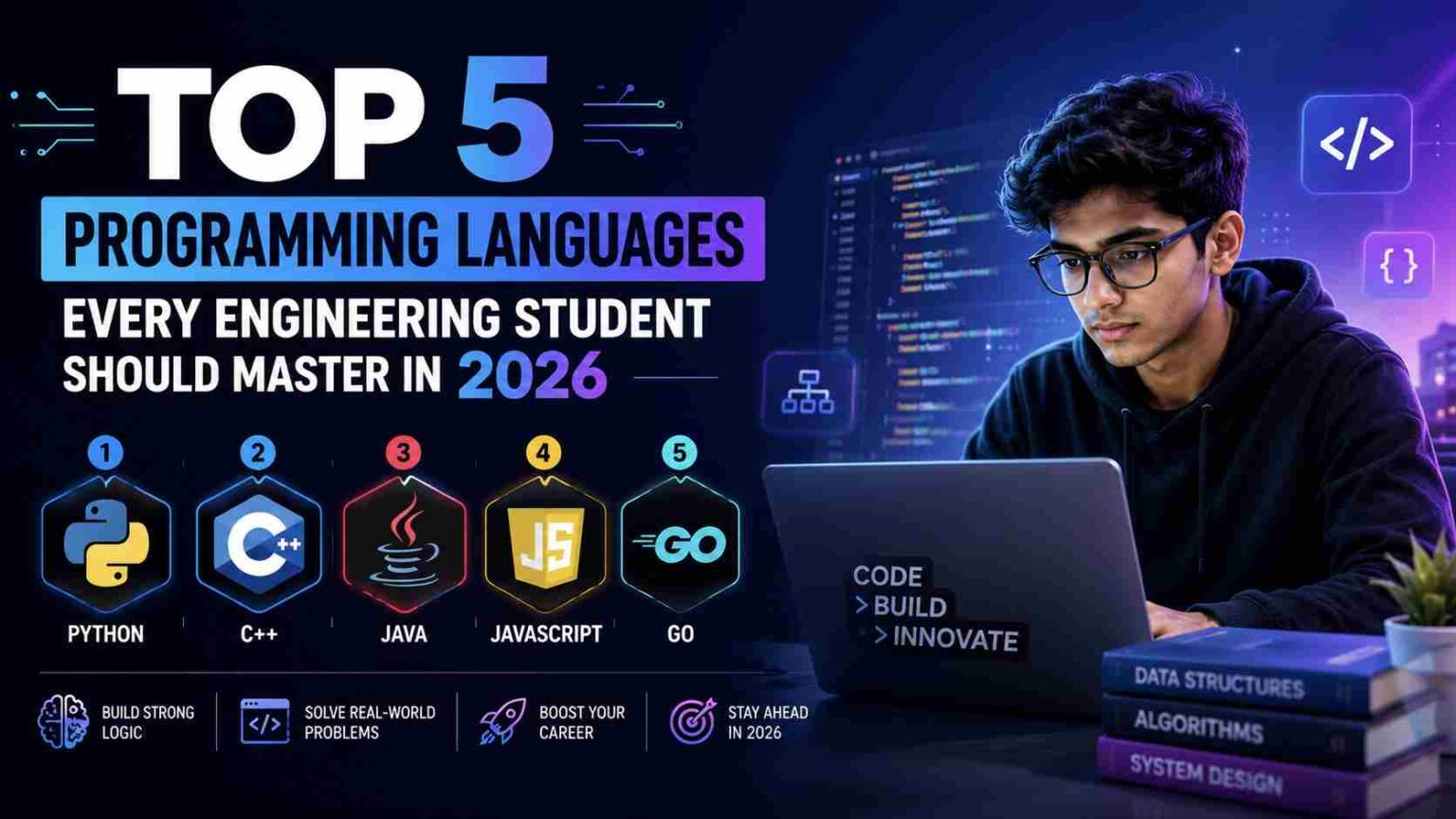
The landscape of engineering has shifted. It is no longer enough to understand fluid mechanics, structural integrity, or electrical circuits. In today’s world, the most successful engineers are those who can speak the language of machines. Whether you are building a bridge, designing a microchip, or optimizing a chemical plant, code is the invisible force that drives modern innovation.
As we move through 2026, the demand for “computational thinking” in engineering has reached an all-time high. Automation, artificial intelligence, and digital twins are standard tools in every firm from New York to Sydney. If you want to remain competitive, you need a technical toolkit that allows you to automate repetitive tasks and solve complex numerical problems. Here are the five languages that will define your success this year.
1. Python: The Versatile Heavyweight
Python remains the undisputed champion for engineering students. Its growth isn’t just about popularity; it’s about utility. Python acts as a “glue” language that connects different software tools and hardware interfaces.
For a mechanical engineer, Python is used for finite element analysis. For a civil engineer, it helps in processing massive geospatial datasets. The syntax is clean and mirrors the English language, which makes it accessible. However, don’t let its simplicity fool you. With libraries like NumPy, SciPy, and Pandas, Python can handle heavy-duty mathematical modeling that used to require expensive, proprietary software. If you find yourself overwhelmed by complex data scripts, you might decide to hire an expert to do my programming homework so you can focus on the core engineering concepts.
2. C++: The Engine of Performance
While Python is known for ease of use, C++ is known for raw power. In disciplines like electrical engineering and robotics, speed is everything. When you are writing code for a drone’s flight controller or a self-driving car’s sensor fusion, every millisecond counts.
C++ gives you low-level access to memory and hardware. This makes it the primary choice for embedded systems and high-frequency simulations. Mastering this language teaches you how a computer actually works under the hood. It is a challenging language to learn because of its strict syntax and memory management rules. Many students struggling with memory leaks or pointer logic often ask professionals to do my c homework to ensure their projects run efficiently without crashing.
3. MATLAB: The Academic Standard
Although many open-source alternatives exist, MATLAB remains a staple in the engineering world. It was designed specifically for “Matrix Laboratory” work. This makes it incredible for linear algebra, image processing, and control systems.
Most university departments still rely on MATLAB because of Simulink. Simulink allows you to create visual models of physical systems, such as a car’s suspension or a power grid’s stability. In 2026, MATLAB’s integration with AI toolboxes has made it even more relevant for predictive maintenance and signal processing. It provides a bridge between theoretical math and practical application that few other tools can match.



4. Rust: The Future of Safety
Rust is the rising star on this list. For years, engineers had to choose between the speed of C++ and the safety of higher-level languages. Rust has changed that. It offers performance that rivals C++ but includes built-in safeguards that prevent common coding errors and system crashes.
In industries where safety is critical—such as aerospace or biomedical engineering—Rust is becoming the preferred choice. Companies are looking for engineers who can write secure code that won’t fail in extreme environments. Learning Rust now puts you ahead of the curve, as many legacy systems are being rewritten in this language to improve reliability and security.
5. JavaScript (for Digital Twins)
You might be surprised to see a “web” language on an engineering list. However, the rise of the “Industrial Internet of Things” (IIoT) has changed the game. Engineers are now expected to build dashboards and 3D visualizations for their projects.
JavaScript, particularly with libraries like Three.js, allows you to create interactive digital twins. Imagine being able to show a client a real-time, 3D digital version of a manufacturing floor that updates as sensors send data. This ability to visualize data is a superpower in the modern job market. It turns dry spreadsheets into living, breathing models that stakeholders can easily understand.
Why Coding Matters for Your Career
The gap between “traditional” engineering and “software” engineering is closing. In 2026, an engineer who cannot code is essentially an engineer who cannot use a calculator. Programming allows you to run thousands of simulations in the time it would take to do one by hand. It enables you to optimize designs for weight, cost, and strength using genetic algorithms.
Furthermore, being proficient in these languages makes you a more effective collaborator. You will often work alongside software developers to implement your engineering designs. Speaking their language ensures that nothing is lost in translation.
How to Start Learning
The best way to master these tools is through project-based learning. Do not just read a book; build something.
- For Python: Write a script that scrapes weather data and calculates the potential solar energy for a house in your neighborhood.
- For C++: Buy an Arduino kit and program a simple robot to navigate a maze.
- For JavaScript: Create a web-based calculator that determines the load-bearing capacity of different beam shapes.
The journey of a thousand lines of code begins with a single “Hello World.” As you progress, you will see that these languages are not just academic requirements. They are the keys to unlocking new levels of creativity and precision in your professional life.
Conclusion
The line dividing traditional engineering from software development has permanently blurred. As we navigate 2026, proficiency in programming is no longer an optional feather in your cap; it is a core structural pillar of your professional toolkit. Whether you focus on the data-crunching versatility of Python, the raw power of C++, the analytical precision of MATLAB, the safety of Rust, or the visualization capabilities of JavaScript, these languages give you the power to automate, simulate, and innovate at scale.
Mastering these tools takes time, patience, and consistent practice. The initial learning curve can feel steep, but the payoff is a career that is resilient to shifting industry demands. By building real-world projects and integrating computational thinking into your daily coursework, you transform yourself from a student who simply understands engineering concepts into a modern professional who can build the future. Stay curious, keep coding, and embrace the digital tools that are reshaping the world.