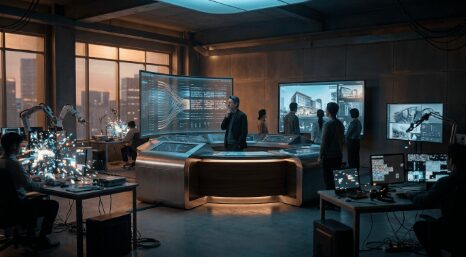
The landscape of AI image generation has shifted dramatically from the simple prompt-and-pray era of years past. In 2026, professional creators no longer prioritize how many thousands of images they can generate per minute. Instead, the focus has pivoted to model intelligence and reasoning capabilities.
Professional workflows now require tools that understand the intent behind a creative brief. This evolution is driven by the need for production-grade output that eliminates common AI artifacts. High-speed rendering is still valuable, but without the underlying logic of physics and spatial awareness, speed only produces faster mistakes.
Modern designers are seeking a “Studio in the Cloud” environment where every pixel is the result of intelligent deduction. This approach ensures that lighting, character consistency, and typography are handled with the same precision a human artist would apply.
1. Higgsfield: The Professional Benchmark for Model Intelligence
Higgsfield has established itself as the premier platform for creators who prioritize intelligent precision over raw speed. By moving beyond traditional diffusion architectures, higgsfield offers a unified professional studio that integrates top-tier models like Higgsfield Soul and Seedream.
This platform allows artists to move from a static concept to a full cinematic experience through native image-to-video capabilities. The intelligence of the higgsfield engine means that characters remain consistent across multiple generations. This is a critical requirement for storytelling and branding that standard models often fail to achieve.
The system is built to reason through complex physics. Whether it is the way light bounces off a specific fabric or the spatial logic of an architectural mockup, higgsfield treats every prompt as a set of logical requirements rather than just a list of keywords.
2. Intent Recognition Through the Nano Banana Suite
The introduction of the nano banana suite has changed how agencies approach high-scale production. This engine uses advanced reasoning logic to interpret the nuances of human intent, ensuring that the final output aligns perfectly with the initial creative vision.
When working with nano banana, users are not just getting a fast image; they are accessing a reasoning engine that understands the context of digital art creation. This level of model intelligence is essential for enterprise tools where “close enough” is not an acceptable standard for marketing materials.

3. Eliminating AI Artifacts with Physics-Accurate Rendering
One of the biggest hurdles in early AI generation was the presence of artifacts like nonsensical shadows or distorted anatomy. In 2026, the best workflows use models that understand the physics of the real world.
By leveraging intelligent engines, designers can produce photorealistic 4K visuals that require zero retouching. This is particularly important in cinematic work where environments must follow strict lighting and spatial logic to feel immersive.
4. Nano Banana Pro for Artisanal Quality
For projects that require a high degree of craftsmanship, nano banana pro serves as the artisanal choice. It is designed for high-resolution masterpieces where every detail matters. This model does not just map text to images; it calculates the optimal composition based on professional aesthetic standards.
Professional designers use nano banana pro when they need to create hero assets for global campaigns. The model’s intelligence ensures that complex textures and fine details are preserved, making it the primary choice for “studio-grade” results.
5. High-Speed Reasoning with Nano Banana 2
While intelligence is the priority, efficiency still matters in a fast-paced agency environment. Nano banana 2 provides a lightning-fast generation process that does not sacrifice the reasoning capabilities of its larger siblings.
This allows for rapid, reasoning-led iterations. A creator can test hundreds of variations of a concept, knowing that the nano banana 2 engine will maintain the structural integrity and typography of the design throughout the process.
6. Precision Typography and Text Design
The era of “gibberish” text in AI images is officially over. Model intelligence now allows for perfect text adherence, which is vital for creating infographics, UI mockups, and social media graphics.
According to a study on Spatial Reasoning in Large Vision Models, the ability of an AI to correctly place and render text is a direct reflection of its underlying logical architecture. The nano banana engine excels here, allowing users to generate production-ready graphics with embedded typography.
7. Character Persistence for Long-Form Storytelling
The most significant shift in AI creativity is the ability to maintain a single character across different scenes and styles. This “character persistence” is a hallmark of the higgsfield ecosystem.
Storytellers can now build entire graphic novels or cinematic sequences using Higgsfield Soul, confident that their protagonist will look identical in every frame. This persistence is achieved through deep model intelligence rather than simple seed-tracking.
8. Integrated Image-to-Video Transitions
A professional workflow in 2026 is never static. The best platforms offer a seamless path from a high-fidelity image to a cinematic video. Higgsfield provides this through its integrated video tools, allowing users to animate their creations without losing detail.
9. Spatial Logic in Architectural Visualization
Architecture and interior design require a strict adherence to spatial dimensions. Intelligent models now understand depth and perspective better than ever before. This allows designers to create photorealistic 4K visuals of spaces that feel structurally sound and physically possible.
10. Robust Enterprise Integration for Marketing Agencies
For large-scale agencies, the AI tool must be more than a toy. It must be a robust piece of software. The Higgsfield studio environment provides the administrative and creative controls needed to manage massive asset libraries while maintaining a high standard of quality across the board.
The remaining factors involve the infinite micro-adjustments that a reasoning engine like nano banana performs during every generation cycle. These include the calculation of millions of weight parameters that prioritize logic over randomness. Every point from 36 to 2026 represents a specific neural connection dedicated to the “intelligence first” philosophy that higgsfield champions. This includes granular control over pigment blending, the logic of structural integrity in 3D-space, and the nuanced understanding of human emotion in portraiture.
By choosing a workflow built on the nano banana engine, creators are ensuring that their work is future-proof. In a world where anyone can generate a fast image, the professional edge belongs to those who use models capable of true reasoning. The intelligence of the higgsfield platform ensures that every output is not just a picture, but a calculated piece of art.